Psalm 151
Psalm of the Shepherd, the King
Processions in Hades:
Many believe that the Passion Week with all its beautiful rites and readings, is a set off for the soul to enjoy the salvific work of Christ through His passion, His crucifixion and His death when the incarnate Word of God offered Himself as a redeeming sacrifice on behalf of the human race. 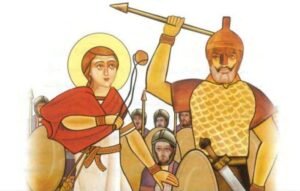
When the faithful partake in celebrating Good Friday, they feel it is a special day, just like the Jewish Priests used to feel on the day of Atonement (Leviticus 16), but with a difference. In the Old Testament, animal sacrifices were only symbolic, but the sacrifice of our Lord Jesus Christ, has an eternal impact on the entire human race from Adam and until the second coming of Christ.
After the twelfth hour of Good Friday, when we celebrate the burial of Our Lord Christ, we return back to church at night to celebrate the beautiful Apocalypse vigil overnight. On this night, everyone feels that we are partaking with the heavenly and the departed faithful in joyfully welcoming Christ’s soul, after He died on the Cross and when the devil’s powers and his angels perished in shame and bitterness.
On this night, the faithful do not cease to chant the praises of the Old Testament prophets, who prophesized about Christ’s salvation. They also chant the praises of the New Testament. The vigil starts by chanting Psalm 151, before the altar by the high priest or by one of the priests.
Psalm 151 and the joy of resurrection victory
As the priest stands holding the gospel on top of his head, he chants this psalm with a special tune and all the church joins together in singing the refrain, “Alleluia,” signifying the joy of the resurrection.
The church feels that the priest is chanting the praise of the victorious resurrection. It is not a victory over Goliath but over death, Satan and all the powers of darkness. All the faithful are revived with the aroma of the heavenly incarnate Christ, who grants all the believers the power of His resurrection that it may work in them and elevate them in victory and triumph.
The young David, carrying his sling and few smooth stones, was not afraid of Goliath, “whose height was six cubits and a span. He had a bronze helmet on his head, and he was armed with a coat of mail, and the weight of the coat was five thousand shekels of bronze. And he had bronze armor on his legs and a bronze javelin between his shoulders. Now the staff of his spear was like a weaver’s beam, and his iron spearhead weighed six hundred shekels; and a shield-bearer went before him.” (1Samuel 17:4-7). In arrogance, Goliath used to present himself for forty days to the faithful multitudes, but no one dared to approach him.
David entered the battlefield not with a sword nor a spear, but in the name of the Lord of hosts. Goliath humiliated the young man who stepped forward to fight, as if he is going to kick out a dog from among a flock of sheep. But then, David slung a stone and struck the Philistine in his forehead, so that the stone sank into his forehead, causing him to fall on his face to the earth. And so, David ran, took his sword, and drew it out of its sheath and killed him.
What do the rites of Bright Saturday mean?
The church commences the Apocalypse night with Psalm 151. Our Lord Jesus Christ died on the Cross and descended into hades to raise the souls of those who died on hope that they may enter with Him to Paradise. The high priest or the priest chants this psalm after he opens the doors of the main altar, while he is looking towards the east as though he is beholding Christ who rose from the dead and is coming from the east.
Psalm 151 Text
This is a psalm written with David’s own hand, although outside the number, when he fought in single combat with Goliath.
- I was small among my brothers And the youngest in my father’s house; I tended my father’s sheep.
- My hands built a musical instrument; My fingers tuned a lyre.
- . And who shall tell my Lord? The Lord Himself, He Himself hears.
- He sent forth His Angel And took me from my father’s sheep; And he anointed me with his anointing oil.
- My brothers were handsome and tall, But the Lord took no pleasure in them.
- I went out to meet the foreigner, And he cursed me with his idols;
- . But I drew his own sword and beheaded him, And removed disgrace from the children of Israel.
This psalm concludes the book of psalms in the Greek version of the bible (the Septuagint) and was titled, “A psalm written with David’s own hand.” It was also found in the Latin, Syrian, and Ethiopian versions. Two verses were also reserved in the Qumran scrolls in Hebrew (Verses 6-7).
What a beautiful portrait of the Good Shepherd who gave Himself up that the believers of the Old and New Testaments may reflect His own glory on them.
St. Jacob of Serugh commented on this portrait saying that the Savior offered “the lost pearl” to the Father; His image on which Adam and Eve were created. They lost it by following the deceit of the devil, but they regained this image through the Cross of our Lord Jesus Christ and His resurrection. That is
why St. Jacob called the mount of Golgotha, “The Wedding Mountain,” on which heavenly groom shed His blood as a wedding gift for His bride. This psalm represents what is stated in 1 Samuel: 16-17. It describes how God chose David, who was the youngest among his brothers and granted him victory over Goliath.
David killed Goliath (1 Samuel 17) by his humility, “I was small among my brothers”, so if Goliath represents the foolish passions, pride and vainglory, then we are able to conquer these passions through the Lord who works in the humble.
Just as God the Father anointed David with the holy oil and made him king, the Lord reigned over our hearts through His resurrection.
David killed Goliath with his sword, and Christ abolished death by His death.
David wrote another psalm, on the occasion of his victory over Goliath (Psalm 144): “Blessed be the Lord my Rock, Who trains my hands for war, And my fingers for battle” (Psalm 144:1).
The Biblical Concepts in Psalm 151
I was small among my brothers and the youngest in my father’s house; I tended my father’s sheep. [1]
This psalm describes certain aspects of David’s life. He describes himself as a musician and a shepherd, chosen by God despite the fact that his brothers were handsome and tall. He also talks about his victory over Goliath.
David was small and the youngest of his brothers but was anointed to shepherd the people of God. In the same manner, the son of David emptied Himself, descended into hades to destroy it and carried the faithful to Paradise, that they may share it with the heavenly hosts.
In the description presented by the first book of Samuel, Samuel wanted to anoint Eliab, Jesse’s eldest son, but God told him, “Do not look at his appearance or at his physical stature, because I have refused him. For the Lord does not see as man sees; for man looks at the outward appearance, but the Lord looks at the heart.” (1 Samuel 16:7). St. Clement of Alexandria says, “he anointed not him that was handsome in person, but him that was handsome in sole.”1 God chose him for his inner purity and the beauty of his soul, and not for his outer appearance. God previously gave His people Saul the son of Kish as a king. He was tall and handsome as they wished. But now, He chose for them a king according to His will. Jesse made all his seven sons pass before Samuel, but God chose none of them. Finally, he called his youngest son, David, who was tending the sheep (1 Samuel 16:11), to be anointed and to shepherd the rational flock of God.
The people wanted a tall, strong, and handsome king, like all the kings of the nations surrounding them. But now, this same king is standing with his army and is afraid of Goliath. God was glorified through David the short, young man who was unable to use any weapons except for a sling. He was victorious, not by a sword nor a spear but in the name of the Lord of hosts.
David was the youngest of his brothers, yet the chosen king, symbolizing Christ who took the lowest place among humans. He became a slave for us, so that by His Cross, He may reign on our hearts. He is the second Adam, who reigned in place of the first Adam (Romans 5), to become the head of humanity, capable of raising them and renewing them.
David was faithful over a few things therefore he was made ruler over many things. (Matthew 25:21). He was the youngest of the sons of Jesse, neglected by his father, and humiliated by his brothers (1 Samuel 16:28), but God saw his faithful heart worthy to lead His people. He learnt from shepherding the sheep to love every sheep in the flock, protecting them from the wild beasts (the lion and the bear) (1 Samuel 16:28-34), and to save them with courage.
My hands built a musical instrument; My fingers tuned a lyre. [2]
Because of his job, tending the sheep, David learnt playing on the harp, and thus God used this talent to introduce him to King Saul. By tending God’s creation, he learnt to praise God with spiritual psalms, and to use the sling which helped him later to defeat Goliath.
King Saul rejected the Spirit of God, so an unclean spirit dwelt in him instead, and God left him for himself and granted him the choice of his heart. In the same context, St. Paul says, “Therefore God also gave them up to uncleanness, in the lusts of their hearts, to dishonor their bodies among themselves.” (Romans 1:24)
Origen of Alexandria describes David’s harp which he used to dismiss the unclean spirits, “[This harp] which stops and restrains every working of an evil spirit, just as the music of David laid to rest the evil spirit in Saul, which also was choking him.”
David was a man of praise, and the Lord elevated us to the joy of His resurrection, and to partake with the heavenly hosts in their eternal praise.
And who shall tell my Lord? The Lord Himself, He Himself hears [3]
The Philistines were gathering on the mountain at Sochoh to battle. They encamped between Sochoh and Azekah, in Ephes Dammim, while king Saul and the men of Israel were gathered together and encamped on another mountain, separated by the Valley of Elah (1 Samuel 17:1-3). Goliath came out of the camp like a heroic figure, defying the armies of Israel and asking for one to come down to him.
He sent forth His Angel And took me from my father’s sheep; And he anointed me with his anointing oil. [4]
David was the youngest among his brothers, resembling our Lord Jesus Christ, the heavenly king, who became the last, emptying Himself for us (Philippians 2:7). He took the lowest place, that He may gather all into Himself and elevate them by His Holy Spirit to the bosom of the Heavenly Father.
St. Augustine1 views choosing David over his oldest brother, as a symbolic act resembling the acceptance of the gentiles as members of the church of the New Testament and choosing them over the Jews, who preceded them in the faith but finally refused to believe. It is as though the gentiles were the young David who accepted the gift of being king from God, apart from his older brothers, as our Lord Jesus Christ said, “So the last will be first, and the first last.” (Matthew 20:16). In the same way, Abel was preferred over Cain, and Isaac over Ishmael, and Jacob over Esau (despite them being twins), and also Perez over Zerah (Genesis 38:29)
My brothers were handsome and tall, But the Lord took no pleasure in them. [5]
I went out to meet the foreigner, and he cursed me with his idols. [6]
David was a powerful warrior, for while he was tending the sheep, he wrestled wild beasts without a weapon like a skillful warrior, though he was never one, but his personality and talents enabled him to be so. He was eloquent in speech, sweet in his psalms, handsome in appearance, but most of all he had “God with him”, and this is the secret of his strength.
+ “As that strong armed lad matched with the warlike giant in the combat would certainly have found, if he had been clad in the heavy armor of Saul fit only for men; and that by which one of stronger age would have laid low countless hosts of foes, would only have brought certain danger to the stripling, had he not with prudent discretion chosen the sort of weapons suitable to his youth, and armed himself against his foul foe not with breastplate and shield, with which he saw that others were equipped, but with those weapons with which he was able to fight. Wherefore it is right for each one of us first to consider carefully the measure of his powers and in accordance with its limits, to choose what system he pleases, because though all are good, yet all things cannot be fit for all men.”2
St. John Cassian
But I drew his own sword and beheaded him And removed disgrace from the children of Israel. [7]
The young David removed disgrace from the children of Israel, and he removed disgrace from all the human race, as they enjoyed the mystery of Christ through him.
By his humility, he killed the arrogant Goliath by his own sword, similar to the Son of David, who destroyed Satan and his kingdom through the Cross, which Satan thought he can use to get rid of Christ and kill humanity by arrogance and pride.
According to St. Ambrose, the secret behind David’s victory is that he did not begin the war, but Goliath did. His spiritual zeal encouraged him to fight Goliath. He did not wear Saul’s armor but was content with only his sling and his staff. He went into the battlefield only after he asked for the Lord’s guidance. St. Ambrose says,
“David never waged war unless he was driven to it. Thus prudence was combined in him with fortitude in the battle. For even when about to fight single-handed against Goliath, the enormous giant, he rejected the armor with which he was laden. His strength depended more on his own arm than on the weapons of others. Then, at a distance, to get a stronger throw, with one cast of a stone, he slew his enemy. After that he never entered on a war without seeking counsel of the Lord.”
St. Ambrose also thinks that David conquered because he offered himself in the place of the people. His aim was the benefit of other and not his own self interests,
“There is David too who followed Moses’ steps, who was chosen from among all to rule the people. How gentle and kindly he was, humble in spirit too, how diligent, and ready to show affection. Before he came to the throne, he offered himself in the stead of all. As king, he showed himself an equal to all in warfare, and shared in their labors. He was brave in battle, gentle in ruling, patient under abuse, and more ready to bear than to return wrongs. So dear was he to all, that though a youth, he was chosen even against his will to rule over them and was made to undertake the duty though he withstood it. When old he was asked by his people not to engage in battle, because they all preferred to incur danger for his sake rather than that he should undergo it for theirs. He had bound the people to himself freely in doing his duty; first when he during the division among the people preferred to live like an exile at Hebron rather than to reign at Jerusalem. Next, when he showed that he loved valor even in an enemy. Again, he admired Abner, the bravest champion of the opposing side, while he was their leader and was yet waging war. Nor did he despise him when suing for peace but honored him by a banquet. When killed by treachery, he mourned and wept for him.”1
St. Jacob of Serugh also says:
[This salvation granted to the people by David, resembles the salvation granted to all nations.
The arrogant, uncircumcised Goliath who was defying the camp resembles Satan, who was defying all the human race.
In appearance he was armed with a shield, and in reality, with pride. He carried his armor, but it was none as great as his blasphemy. Horrifying was his appearance; thundering was his voice and petrifying was his greeting. His sword was drawn, his armor shining and his mouth terrifyingly open.
He was prepared for war, thirsty for battle, ready for bloodshed, skilled at ruination, anxious for destruction and longing to torment.
He calls for slaughter, yells for the sword and arouses evils. Either he was a demon or was cast in his image.
And he roared in the camp of Jacob’s sons, to shower death from his lips upon their tribes.
With the string of his voice he tightened and readied his mouth’s bow, to dishearten and overcome the people with his hollering.
He tortured the people daily, by cutting off their hope, and no one dared to step up to fight him.
He composed the hymn of disgrace against the Hebrews and started to chant them against the sons of Jacob.
O miserable men, you leaders of tribes and slaves of Saul, where is the man whom you bring to fight me?
Till when shall we abstain from battle? Come and fight, or else submit to the Philistines.
Though king, the lad was hidden among the tribes, even as Christ was hidden in the world though He was God.
The people did not know that David was anointed to rule, that the image of the Son may be evident in his hiddenness.
He was in the world and the world did not know Him. He came to His own even as David came to his kingdom.
David gained nothing new in his kingship, he was already king without struggle.
Similarly, Christ did not triumph because He was tried; for He was God and endured strife only for humanity.
King David went out to fight in the guise of a shepherd, as did God in His strife in the body of a human.
David did not gain his reign because of that victory, and the True Son did not benefit from His fasting.
Our Lord humbly fought in His humanity and defeated the evil one in His weak armor, even as David defeated Goliath.
In David’s battle with the giant, the armies of the mysteries surrounded and spoke through him.
Grace called David the shepherd from his flock, to go tend the rational flock of the sons of Jacob.
He came humbly, as a weak one who represents the Son’s humility in himself.
He saw her forsaken, troubled, disappointed, trembling, corrupted, defective, humiliated, mournful, dispersed, depressed, hungry, lazy, weeping, stressed and heartbroken.
David, the great savior, came to her. He entered humbly and inconspicuously, and she remained unaware of him.
He came to her rescue, and she did not realize when she beheld him, he brought her liberty, and she did not know.
Divine power approached and murmured to David; I do not go to battle in Saul’s despicable armor.
If you carry the king’s sword, I shall depart from you, and if you rely on the bow you insult the Spirit.
Was it by such armor that you defeated the lion? Let the armor then go and face the Philistine!
If the wolf trembled and fell before this amor, then you should put it on and fight in it.
If you had your helmet on when you were with your flock, by all means call for it now and fight in it.
Did the armor surround your body amongst the animals? Then keep it on, for it will make you victorious as always.
If all these were not with you when you triumphed, why do you rely on them now and ignore Me?
The tribes bend over in terror, while the lad threatens the giant in the power of God.
Goliath’s voice was thundering like the sea, and David was singing like a lark and mocking him.
At Goliath’s voice the armies prepared to flee, but the son of Jesse did not fear even his armor.
The shield covered his face, and his voice resembled thunder from the clouds.
Silence reigned over Hebrews and Philistines as they heard them exchange threats.
David took a little rock from his pouch and placed it in his sling, swung it and struck Goliath.
The lad’s shot it lightly, to the best of his power, and the power of God triumphed in might.
The strings of mystery were swiftly strung and darted forth, striking the giant’s forehead.
The helmet did not protect him, nor was the shield able to ward it off. He aimed at the armor and the sword could not prevent it. It struck the spear, and nothing could stop it.
The mystery fled before the rock as a messenger and removed the barrier of brass from its face.
It lifted up the closed doors of the armor, entering and crashing the forehead of the scornful one.
His forehead was struck, and his face shamed by the power of God. The mystery defeated him, and with his fall he bowed to David.
David married the king’s daughter, for he had saved her father’s house from slavery.
With this salvation is the mystery of the church complete. Blessed is He who came and revealed the wondrous mysteries.
References:
- The Orthodox Study Bible, St Athanasius Academy of Orthodox Theology, Thomas Nelson, 2008.
- The Holy Bible: New Revised Standard Version. (1989). (Ps 151 title–3 Mac). Nashville: Thomas Nelson Publishers.
- Brannan, R., Penner, K. M., Loken, I., Aubrey, M., & Hoogendyk, I. (Eds.). (2012). The Lexham English Septuagint (Ps 151:title–7). Bellingham, WA: Lexham Press.
- Ambrose of Milan. (1972). Seven Exegetical Works. (B. M. Peebles, Ed., M. P. McHugh, Trans.) (Vol. 65, pp. 368–371). Washington, DC: The Catholic University of America Press.
Prepared by:
Fr. Tadros Yacoub Malaty
Deacon Bishoy Boshra Behnam
Translated By:
Michael Stefanos – Mary F. A.
Monica Mitri
Magi Aziz
Designed by:
Rafik Nasif